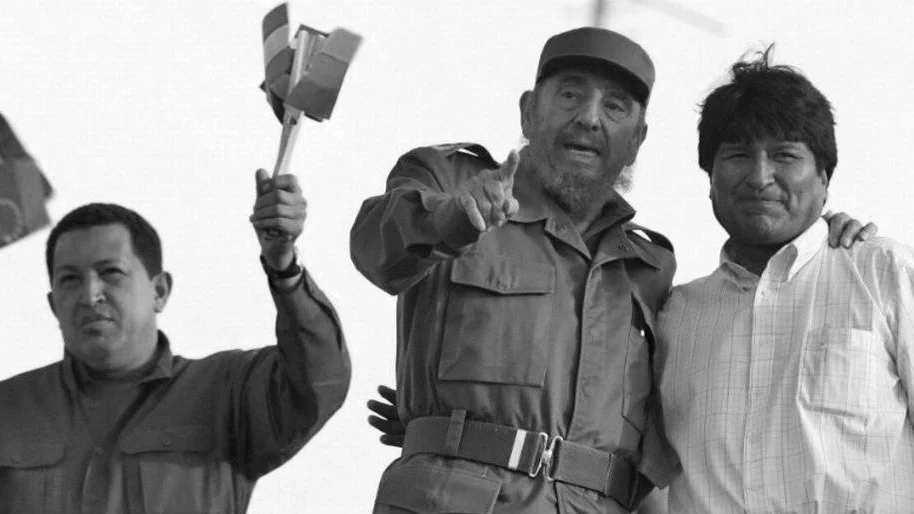
“The Architects of Hemispheric Disorder”
This 2011 undergraduate essay marked one of my earliest attempts to engage the geopolitical shifts reshaping the Western Hemisphere. While it lacks the conceptual and historical frameworks I work with today, its core intuition remains: that asymmetric threats to American power were accelerating in Latin America, foreshadowing the region’s emergence as a frontline in great power competition. I’ve kept it here as a window into how I first approached these issues and how my thinking has developed since.
Latin America as the New Arc of Crisis: Cuba and the Spread of a Hemispheric VIRUS
By Johannes Schmidt
After the fall of the Soviet Union in the winter of 1991, the United States found itself in a unique situation of complete, undisputed global hegemony. Since assuming this position, it has been the world’s primary economic, military, sociocultural, and political leader, encountering little, if any, direct opposition to its role as a superpower. As Brzezinski explains in his book The Choice, “the contemporary world may not like American preeminence — may distrust it, resent it, and even at times conspire against it. But as a practical matter, it cannot oppose it directly.”[1]
This legitimization by common global consensus, however, is rapidly changing. While the global balance of power has been unipolar since the Soviet collapse, American dominance in recent years has faced a rising tide of asymmetric threats from a wide range of global actors. The legitimacy of American hegemony has come under growing challenge, and so the world must now ask itself: is the global community undergoing a shift in power? And if so, both why and how?
Brzezinski suggests that American hegemony is being questioned because of a global perception that the United States has abused its power as the sole hegemon. He explains that “conduct that is perceived worldwide as arbitrary could prompt America’s progressive isolation, undercutting not America’s power to defend itself as such, but rather its ability to use that power to enlist others in a common effort to shape a more secure international environment.”
This isolation of the United States by the global community, coupled with the mounting challenges to American power abroad, has created a potentially chaotic international reality in which the world’s preeminent superpower is absent. Furthermore, it has facilitated the cooperation of actors that, outside the context of anti-Americanism, would have little reason to interact or align their foreign policies.
This essay will explore how the United States’ post–Cold War claim to hegemony is being asymmetrically challenged by Cuba through its use of Venezuela as a patron state — much as it once relied on the Soviet Union to advance its interests; how Castro managed to orchestrate the ideological exploitation of other would-be global powers through their entry into the region; and, finally, how the Castro brothers have reshaped global geopolitics by turning America’s own backyard into the frontline of great-power competition.
To better understand the new challenges facing the United States, one must first grasp the traditional meaning of hegemony, especially in the American context. For the purposes of this essay, hegemony should be understood through the lens of an anarchical world in which international politics is a struggle for power. From this perspective, states tend to rely on their actual capabilities to protect and define their interests within the global system. To ensure national security, hegemons inevitably flex their political and military muscle.
Historically, states seeking hegemony have asserted their power both within their own region and within what Brzezinski calls “The Arc of Crisis.”[2]
There has long been an assumption that hegemony is measured by action in the “arc of crisis.” While this may hold true, the United States’ failure to build sustainable democracies and set achievable goals in Iraq and Afghanistan — combined with its simultaneous and blatant neglect of Latin America, just as anti-American and anti-democratic regimes were rising — created a situation it had never before faced. For the first time in the history of American hegemony, its global supremacy was being challenged and, crucially, defined in its own hemisphere.
Even though the United States had enjoyed regional dominance since the Monroe Doctrine of 1823, it now had the daunting task of moving to prevent “elements hostile to [its] values and sympathetic to [its] adversaries”[3] from asserting any influence in its own back yard. While the United States spent years focusing on an unsustainable war effort, Cuba’s Castro Regime had opened the doors of the Western Hemisphere to state and non-state actors whose only motivation to mobilize in the region was to destabilize and undermine American global supremacy. As Tim Rush commented in his 1980 piece titled “Is Cuba Fomenting Revolution to Get to Mexico’s Oil?,” “the ultimate aim of Cuba and the Soviet Union is to create an ‘Arc of Crisis’”[4] in the region. It is the belief of this essay that Cuba, with the help of its Venezuelan ally, achieved just that.
The Castro Brothers and Their Anti-American Revolution
From the moment the Cuban Revolution was born in January 1959, the United States was wary of its enigmatic leader, Fidel Castro. By the time of the 1960 election in Washington, however, “the White House had come to regard Castro as the most dangerous revolutionary in the Third World,” as Castro moved to nationalize American companies and delivered fiery “anti-imperialistic” rhetoric at the 1960 United Nations General Assembly in New York City, pledging support for national liberation movements around the world.[5]
The Cuban Revolution’s anti-American stance might have remained a minor annoyance had Castro not developed a fierce determination to bring about the demise of the “American Empire” following the 1961 Bay of Pigs fiasco. That event marks the turning point that transformed Castro into the most dangerous actor on the anti-American stage. As the U.S. State Department notes, “Castro declared Cuba a socialist state on April 16, 1961,” and “pursued close relations with the Soviet Union, working to advance its geopolitical goals by funding and fomenting violent subversive and insurrectional activities and participating in foreign interventions until the collapse of the U.S.S.R. in 1991.”[6]
The true nature of Castro’s intentions was laid bare during the 1962 Cuban Missile Crisis, when Castro advocated for a Soviet first strike against the United States, writing to Khrushchev, “the Soviet Union must never allow the circumstances in which the imperialists could launch the first nuclear strike against it.” In doing so, Castro revealed a willingness to sacrifice his own people for his anti-American cause. Khrushchev, however, chose diplomacy and concessions to resolve the crisis — but the world had already seen the extent of Castro’s threat.[7][8]
Even without the freedom to pursue the collapse of Pax Americana under the Soviet umbrella, Cuba continued to erode American hegemony both within the hemisphere and beyond. It did so through asymmetric warfare, including state-sponsored terrorism and support for communist revolutions across the globe.
Cuba: Phases of State Sponsored Terrorism
1962 was a year of mixed emotions for the Cuban revolution. On one hand, the government celebrated an unprecedented victory over the Yankee invaders at the Bay of Pigs, catching the eye of the Soviet Union; on the other, the Soviet Union prevented the Castro regime from engaging in direct confrontation with the United States during the Cuban Missile Crisis by pulling its missiles from the island. Fidel never truly recovered from that sense of crisis, and his words—“let us face the enemy... with the conviction that to die for the country is to live, and to live in chains is to live in shame and disgrace”—have defined his foreign policy ever since. Knowing that Cuba lacked the capability to confront the unmatched U.S. military directly, Castro turned to asymmetric measures.[9]
Crystal Schaeffer explains:
State-sponsored terrorism, depending on how states implement support, has been linked to new forms of warfare, low-intensity conflicts, protracted political warfare, surrogate warfare, proxy warfare, and an indirect form of aggression. This association with covert or surrogate warfare was created because weaker states often use terrorism as a form of asymmetric warfare against larger, more powerful states without the risk of retribution. SSTs are also frequently considered rogue, pariah, outlaw states, or states of concern.[10]
Given Cuba’s foreign policy—which has backed anti-Western revolutions across Asia, Africa, and the Western Hemisphere—it’s clear that Castro has been engaged in a long war against the United States since the revolution’s beginning. That war has evolved through three key stages of state-sponsored terrorism.
Schaeffer outlines:
The first phase involved heavy Cuban support, though not always delivered effectively or in ways that fully advanced the interests of the terrorist groups it backed. The second phase, spanning the 1970s up to the Soviet collapse, marked a period when Cuba refined its support to make it more strategically useful, achieving far greater success in fomenting communist revolutions worldwide. The third phase, after the fall of the Soviet Union, was defined by Cuba’s lack of ideological and financial backing from its closest ally. Without Soviet money, Cuba was forced to turn inward and focus on its own survival.
This essay argues that in recent years, we’ve entered a new, more dynamic fourth stage of Cuban state-sponsored terrorism. The United States’ failure to meet its hegemonic obligations in the region, the rise of an ideologically aligned Cuban patron state, and a broader global shift favoring powers hostile to American dominance have all emboldened Cuba. With the U.S. distracted abroad, Cuba has thrown open the doors of the hemisphere to old and new allies, all intent on bringing the American giant to its knees.
Cuba sees this fourth stage as its last shot at a David vs. Goliath victory. It need only help stir regional destabilization and seize a leadership role, even claiming credit where it may not fully be due. Beyond passive acts like sheltering terrorist groups, Cuba can build ties across the region by offering international backing to states opposing U.S. interests. It can also escalate its provocations by granting rival powers footholds on its own soil.
We’ve already seen signs of this: the 2009 strategic agreements between Cuba and Russia, and Cuba’s open support for Iran’s nuclear ambitions at the NAM summit in Havana.[11] For Cuba, surviving the embargo and witnessing the erosion of American dominance in its own hemisphere would mark not just a political victory, but the ultimate vindication of its revolution.[12]
Castro’s Last Act on the Stage of Hegemonic Decline
With the Castro regime approaching a natural end, locked in place by its refusal to hand over power from the old revolutionary guard, the brothers have nonetheless shown remarkable tact in maneuvering through world affairs. Two key elections marked the moment Cuba realized a new stage in its long war with the United States was possible: first, the 1998 election of Hugo Chávez in Venezuela, and second, Iran’s 2005 election of Mahmoud Ahmadinejad, who came to power vowing to confront “Western decadence.”
These events are crucial for understanding Cuba’s evolving foreign policy and its approach toward the United States. They handed the Castro regime ideological allies that, unlike Cuba, were far less subtle in confronting U.S. power. More importantly, they offered something the Soviet collapse had taken away: two states with global leverage thanks to vast oil reserves and OPEC influence, states willing to back Cuba’s project of American destabilization—and willing to pour money into the Cuban economy as the Soviets once had. This time, however, Cuba was not the junior partner; it was treated as an equal.
It must be underscored: Cuba is no subordinate player in this new phase of regional re-polarization. On the contrary, it has played a vital role in Chávez’s consolidation of power, in the rise of leftist regional movements, and in opening the hemisphere to foreign actors. By its revolutionary nature, the Castro regime remains a natural leader within the anti-imperialist movement.
Dangerous Actors and the VIRUS They Spread
As the United States enters a period of decline, with its global hegemony increasingly challenged, a range of states has stepped forward, aiming to exploit America’s weakened position. Unlike Europe or China—powers largely content with a gradual move toward multipolarity—these actors seek to actively destabilize American hegemony in their own regions. Many of these states and non-state actors have been welcomed into the Western Hemisphere by Cuba and its ideological ally, Venezuela.
It is no secret that since its 1959 revolution, Cuba has worked to cultivate ties with anti-imperialist regimes and insurgent movements. It has played an active role in organizations like OSPAAAL and the Non-Aligned Movement, both defined by their anti-imperialist agendas.[13] Cuba has also worked to build relations with states whose main shared trait is a deep-seated anti-Americanism—extending even to hardline theocracies like Iran. In 2001, Fidel Castro toured Syria, Libya, and Iran—three well-known state sponsors of terrorism—and in Tehran declared, “Iran and Cuba, in cooperation with each other, can bring America to its knees.”[14]
A prime example of Cuba’s success in this sphere is the ALBA bloc’s expanding ties with Iran and Russia, two nontraditional actors in the Western Hemisphere that share long-standing connections to the Castro regime. Together with Venezuela, Iran, and Russia—the so-called VIRUS nations—Cuba has employed asymmetric strategies to exploit America’s declining global position and expand influence in the Andes, the Middle East, and Eastern Europe.[15] As Professor Sean H. Goforth puts it, “VIRUS is a political pact that bolsters military capacity and extends diplomatic cooperation to magnify regional influence.”[16]
By partnering with non-state actors like Hezbollah, Hamas, and FARC, integrating their national economies, and pursuing military and trade alliances, Cuba and its VIRUS partners are steadily eroding Western dominance. For the Americas, the most urgent danger is that American influence could be displaced—or at least diluted—by states deeply hostile to Western values. This challenge disrupts the expected transition of hegemonic power, where Western democracies (particularly the EU nations) were assumed to be next in line to shape a multipolar system. Instead, states like Iran and Russia are making strategic inroads into America’s “backyard,” pushing themselves to the forefront of international politics.
The political fallout from the “War on Terror” has further weakened America’s ability to rely on both regional and extra-regional allies. As a result, Washington finds itself unable to block the VIRUS nations from expanding their footprint in the Western Hemisphere. Unlike the 1962 Cuban Missile Crisis, the United States today lacks the leverage to dictate who holds influence in its own neighborhood. For the first time, countries once under American dominance are now shaping influence over America itself. What we are witnessing amounts to a kind of Cuban Missile Crisis 2.0—except this time, the United States may be too constrained to stop the foreign encroachment.
Economic Implications of VIRUS Integration
Economically, the threat posed by the VIRUS nations arises from the growing integration of the South American economy through institutions such as ALBA and UNASUR, alongside increasing economic cooperation and foreign direct investment from Iran, Russia, and China. To fully grasp this threat, it’s important to recognize that both ALBA and UNASUR were created with the explicit goal of fostering Latin American interdependence and reducing reliance on the U.S. economy.
While both organizations are still evolving, Venezuela—the United States’ third-largest oil supplier—has already reduced its trade with the U.S. since 2006. According to a 2009 report by the Venezuelan-American Chamber of Commerce and Industry, total trade between the U.S. and Venezuela “declined by nearly 53%” between the first half of 2008 and the first half of 2009. This shift was made possible by Venezuela’s aggressive diversification of trade partners, signing agreements with Russia, Japan, and China that included $30 billion, $8 billion, and $6 billion investments, respectively, in developing Venezuela’s Orinoco Oil Belt. Alongside treaties with regional players like Argentina, Bolivia, Paraguay, Cuba, Uruguay, and Ecuador, Venezuela has progressively redirected its oil industry—which, according to the BBC, accounts for 90% of its exports—away from the American market. Non-oil trade has also expanded among ALBA and UNASUR members in recent years.[17]
Today, as U.S. oil imports decline from suppliers like Saudi Arabia, Mexico, and Nigeria—remaining stable only with Canada—the United States can ill afford disruptions to its energy supply. Venezuela and Iran, both top-five oil producers in OPEC, wield considerable influence over the organization’s decisions when acting as a bloc. Similarly, Russia, which “pumps about 9.8 million barrels of oil a day and exports about seven million barrels of crude oil and refined products,” ranks as the world’s second-largest oil producer after Saudi Arabia and plays a major role in shaping global output. Together, these three major oil producers are slowly tightening their grip on the American economy.[18]
If working as a bloc—with the possible support of Brazil, whose oil production has doubled in the last decade—the VIRUS nations could effectively reduce global oil output while offering preferential sales to allied nations, essentially raising the price of crude per barrel and limiting American imports. If the push toward Latin American interdependence, with its emphasis on diversifying international trade partnerships, is pursued aggressively, as the Bolivarian Revolution envisions, it is plausible that within a decade the VIRUS nations could redirect their oil away from the United States, potentially triggering an economic energy crisis that would undermine America’s ability to fulfill its hegemonic responsibilities and weaken its status as a superpower. For Latin American states, no longer fully dependent on the American economy, the gains in relative power could outweigh any losses incurred by a weakened U.S. economy.
Furthermore, the implications of increased trade and cooperation between the VIRUS nations and Latin American trade blocs suggest that Russian and Iranian influence in the region will continue to grow. This cooperation has already produced concrete results: the creation of a joint Venezuelan-Iranian bank, Iran’s plan to launch an Arabic TV network based in Ecuador, the expansion of Iranian embassies across the continent, the establishment of various Latin American–Iranian mining and oil ventures, and a recent €500 million credit line extended to Cuba.[19][20] Similarly, Russia has expanded its presence in Latin America by constructing weapons factories, offering to station strategic bombers in Cuba, and advancing plans to establish a nuclear reactor in Venezuela.
China, although not as explicitly anti-American as the VIRUS nations, supports the idea of a multipolar world and has invested billions in Latin America to secure access to commodities such as iron and other ores, soybeans and soybean oil, copper, iron and steel, integrated circuits, and oil—resources critical to sustaining China’s booming economy. Latin America was reassured of China’s commitment when, during a speech to the Brazilian Congress, President Hu Jintao announced that China would invest $100 billion in Latin America over the next decade.[21] These investments have created vested interests on the part of Iran, Russia, and China in Latin American sovereignty and stability.
For this reason, as VIRUS and Chinese investments expand and their presence deepens, U.S. influence in the region continues to erode. It must be understood, however, that while these measures have the potential to harm the American economy and diminish U.S. influence, they cannot fully topple the American economy or do more than accelerate the pace of American hegemonic decline. Any attack on the U.S. economy, after all, would amount to an attack on the global economy.
It is also worth noting that Venezuela’s current economic strength has allowed it to provide Cuba with more than $4 billion per year in aid—an amount comparable to the assistance Cuba once received from the Soviet Union. This aid has enabled the Cuban government to withstand the effects of the American embargo. Additionally, the rise in trade with nontraditional partners drawn to the region by the efforts of Castro and Chávez has worked to boost Cuba’s GDP to extraordinary levels since 2006.[22]
Military Threats
Thus far, the political and economic strategies described represent peaceful and gradual efforts to erode U.S. hegemony in the Western Hemisphere. However, the entry of anti-American actors onto a stage located squarely within the U.S. sphere of influence introduces potentially violent dimensions. In recent years, Hugo Chávez’s Venezuela has displayed a marked obsession with expanding its military power and regional influence. Since 2008, Venezuela has spent approximately $10 billion on arms purchases from Russia. Following a meeting between Chávez and Putin, the latter remarked that “our delegation has just returned from Venezuela, and the overall volume of orders could exceed $5 billion.”[23] Prior to that, Venezuela had already acquired billions of dollars’ worth of Sukhoi jet fighters, Kalashnikov assault rifles, T-72 tanks, and S-300 advanced anti-aircraft missile systems.
These purchases have been bolstered by Venezuelan plans to build Russian arms factories domestically to export weapons abroad. This export agenda has hardly been a secret; intelligence agencies worldwide have reported that “Venezuela has been serving as an intermediary providing arms to Iran since 2006,”[24] and that Venezuela is also being considered as a base for Iranian arms factories. In 2008, Chávez and Ahmadinejad signed a memorandum of understanding (MOU) on military cooperation that included “training and mutual exchange of military experiences.”[25] Acting on this framework, Chávez entered into mutual defense agreements with Russia and his South American neighbors through the defense clause outlined in the UNASUR treaty.[26]
Over the past year, reported discussions between Chávez and Russian President Dmitry Medvedev have raised the possibility of establishing a Russian air base in Venezuela for Tu-160 “Blackjack” strategic bombers, two of which flew to Venezuela in September 2008. Some reports even claim that Chávez announced Russian troops would be welcome on Venezuelan soil, though this remains unlikely for now. [27]Meanwhile, U.S. intelligence reports indicate that Iran deployed Qods forces—“Islamic shock troops deployed around the world to advance Iranian interests”—to Venezuela. According to these reports, Qods forces “engage in paramilitary operations to support extremists and destabilize unfriendly regimes,”[28] with warnings that the United States may ultimately have to confront them, particularly in Colombia. Furthermore, reports caution that Qods forces are training and establishing terrorist networks across South America that “could be called to attack the United States in the event of a conflict over Iran’s nuclear program.”[29] Additional reports have surfaced about the presence of Hamas and Hezbollah militants in Venezuela. Clearly, the situation poses a serious threat to U.S. interests in the region.
While the VIRUS nations are unlikely to directly challenge the United States militarily, recent history has shown that Venezuela is willing to mobilize its forces to defend national sovereignty. In 2008, Colombian troops crossed into Ecuador to pursue FARC militants, killing a commander and raiding a rebel camp. This violation of Ecuadorian sovereignty prompted both Venezuela and Ecuador to mobilize troops to their borders and sever diplomatic ties with Colombia. Outraged that Colombian forces had “invaded Ecuador, flagrantly violating Ecuador’s sovereignty,” Chávez warned Colombian President Uribe that if Venezuelan sovereignty were similarly violated, he would “send some Sukhois.”[30] Since that border conflict, diplomatic ties have been restored between Venezuela, Ecuador, and Colombia, but now, armed with advanced foreign weapons, reinforced by foreign paramilitaries, and shielded by mutual-defense agreements, ALBA nations are positioned to potentially challenge the United States indirectly—particularly through Colombia, which recently accepted a U.S. proposal to host a military base.
Conclusions on Cuba’s Final Stance
In order to understand Cuba’s role in this essay, one must first recognize that its role is fundamentally asymmetric. For nearly 50 years, Cuba has waged an asymmetric struggle against the United States, its ideological adversary. Its mission has been the survival of the revolution—withstanding the embargo and sustaining a communist economy just 90 miles from U.S. shores, an achievement few other Central American nations would have considered possible during the Cold War.
It is precisely for this reason that the entry of outside powers into the Western Hemisphere, working alongside Cuba and other regional players—chiefly the ALBA nations—represents a fundamental victory for Cuba. Cuban involvement in the destabilization of American hegemony enables Havana to claim that its “anti-imperialist” mission, and thus its revolution, has been vindicated.
The introduction of ideologically anti-American forces into a region once securely under the shadow of the Monroe Doctrine profoundly challenges the very notion of U.S. supremacy and global leadership. And with the United States today unable to prevent the advance of these state and non-state actors, one must ask: how will this new arc of crisis reshape the future of global geopolitics?
_________________________________________________________________________________
[1] Brzezinski, Zbigniew. The Choice: Global Domination or Global Leadership. New York: Basic Books, 2005.
[2] “IRAN: The Crescent of Crisis.” TIME, 15 Jan. 1979. Web. Accessed 19 Dec. 2010. http://www.time.com/time/magazine/article/0,9171,919995,00.html.
[3] Ibid
[4] Tim Rush, “Is Cuba Fomenting Revolution to Get at Mexico’s Oil?” Executive Intelligence Review 7, no. 14 (1980)
[5] Allida Black et al., eds., Eleanor Roosevelt, John Kennedy, and the Election of 1960: A Project of The Eleanor Roosevelt Papers (Columbia, S.C.: Model Editions Partnership, 2003)
[6] Alfonso, Pablo. “U.S. Leads in Authorizing Humanitarian Aid to Cuba, State Department Says.” The Americas, Print.
[7] Fidel Castro, “Telegram from Fidel Castro to Nikita Khrushchev, October 26, 1962,” John F. Kennedy Presidential Library and Museum.
[8] Taubman, William. Khrushchev: The Man and His Era. New York: W. W. Norton & Company, 2004.
[9] Tunzelmann, Alex von. Red Heat: Conspiracy, Murder, and the Cold War in the Caribbean. New York: Henry Holt, 2011.
[10] Schaeffer, Crystal M. State Sponsorship of Terrorism: A Comparison of Cuba’s and Iran’s Use of Terrorism to Export Ideological Revolutions. PhD diss., George Mason University, 2010.
[11] “The Devil Skips the Havana NAM Summit.” Cuba Absolutely Magazine. Nov. 2011.
[12] “Cuba, Russia Renew Alliance.” Pittsburgh Post Gazette [Pittsburgh], 31 Jan. 2009. Print.
[13] Raúl Gómez Treto. The Organization of Solidarity of the Peoples of Africa, Asia and Latin America (OSPAAAL): An Instrument of the Cuban Revolution. Miami: Institute of Interamerican Studies, University of Miami, 1981.
[14] “Cuba-Iran Axis?” Center for Cuban American Studies. Web. Nov. 2011.
[15] Sullivan, Mark P. “Latin America: Terrorism Issues.” Congressional Research Service, 2009. http://fpc.state.gov/.
[16] Goforth, Sean H. “Analysis: A Global V.I.R.U.S of Instability.” Foreign Policy Association, 2010.
[17] Suggett, James. “Venezuelan Trade Declines with US, Increases with Brazil, Russia, China, Japan.” Venezuelan Analysis, 2009. http://venezuelanalysis.com/.
[18] Painter, James. “Is Venezuela’s Oil Boom Set to Bust?” BBC News, 2009.
[19] AFP. “Iran, Venezuela Launch Joint Development Bank.” Agence France-Presse, 2009.
[20] “Iran, Cuba Sign Economic Cooperation Agreements.” Tehran Times, September 9, 2011.
[21] “CHINA'S Foreign Policy and ‘Soft Power’ in South America, Asia, and Africa.” U.S. Government Printing Office, November 2011.
[22] Alfonso, Pablo. “U.S. Leads in Authorizing Humanitarian Aid to Cuba, State Department Says.” The Americas. Print.
[23] Associated Press. “Russian PM Putin Eyes $5bn Arms Deals with Venezuela.” BBC News, 2010.
[24] Cochrane, Richard. “Iran’s Secret Arms Plants in Venezuela: Algerian-Russia Arms Network Linked to Tehran; Ahmadinejad Plans Militarization.” Richard Cochrane, 2009.
[25] “Iran, Cuba Sign Economic Cooperation Agreements.” Tehran Times, 9 Sept. 2011. Web.
[26] “Iran, Venezuela Enter into Military Alliance.” Press TV, 2009.
[27] “Russian Officials Visit Venezuela.” El Universal, September 10, 2008.
[28] Bill Gertz. “Iran Boosts Qods Shock Troops in Venezuela.” The Washington Times, 2010.
[29] Gertz, Bill. “Iran Boosts Qods Shock Troops in Venezuela.” The Washington Times, 2010. http://washingtontimes.com/.
[30] Associated Press. “Colombia Neighbours Deploy Troops.” BBC News, 2008.